
Showing posts with label Narrative. Show all posts
Showing posts with label Narrative. Show all posts
Thursday, December 11, 2014
Summarizing
When we summarize a story, we find all the main ideas of the story. Together, all of the main ideas of the story are called the summary. The summary is a shortened version of the story.


Sunday, November 9, 2014
Theme
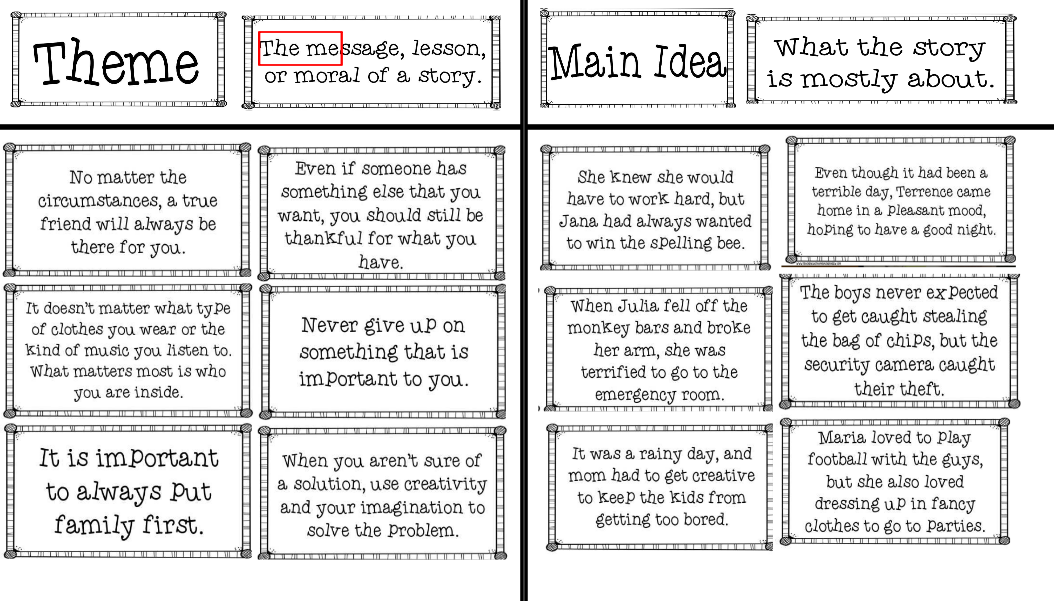
The theme of a story is the moral message or lesson of a story.
THE MESSAGE
The Main Idea of a story tells what it is mostly about.
(One Sentence Summary)
Below is our anchor chart that illustrates the difference.
Thursday, November 6, 2014
Red Herring
Red Herring
- A red herring is used in mysteries and thriller stories to distract the reader from identifying the real culprit.
- The red herring in a story can take the form of characters that the reader suspect, but who turn out be innocent when the real murderer is identified.
- It aims at keeping the readers guessing at the possibilities until the end and therefore keeps them interested in the story.
- The readers enjoy solving the mysteries created by red herrings in the story. Undoubtedly, it would be difficult to keep the reader’s interest, if we knew which way the plot would go from the start.
One for the Murphy's isn't a mystery or a thriller, but the author does use red herring to hook her reader.
- Do you think Carley will stay with the Murphys or go back to live with her mother?
- What text evidence does the author use to lead you to a conclusion?
Sunday, November 2, 2014
Symbolism
SYMBOLISM
Symbolism is giving special meaning to objects, things, relationships or events.
Symbols are objects, things, places, characters, figures, events, sounds or colors used to represent abstract ideas or concepts. A symbol is the physical representation of a concept or an idea.
Symbolic Significance is the meaning or understanding beyond symbols.
What do we need to know so we can have a better Understanding of Symbolism?
- Symbols are tangible (touchable) objects that represent intangible (untouchable) ideas.
- Something that is tangible is concrete. Something that is intangible is abstract.
- Nouns are people, places, objects, and things which are concrete—physical.
- Nouns are also concepts and ideas which are abstract—not physical.
- Symbols are concrete or literal items that represent abstract or symbolic ideas.
|
Symbol
|
Symbolic Significance or Meaning
What it Represents
|
Conflict
CONFLICT
The plot of almost any story centers on conflict. A conflict is a struggle between opposing forces.
There are two main kinds of conflict: external and internal.
External Conflict
|
When a character faces an outside force this is known as external conflict. During the course of a story, characters may face numerous types of outside forces. The outside force may be another character, or a group of people promoting their beliefs, or even be the forces of nature (storm, plague, drought).
Man against Man
Man against Nature
Man against Society
Man against the Supernatural
Man against Technology
Man against the Unknown
Internal Conflict
A struggle that takes place in a character’s mind is called an internal conflict. They character has to make a moral decision—to choose between what is considered right and what is considered wrong. Sometimes a character has to make a choice where there are two equally unlikeable solutions but the choice has to be made. When a character experiences these emotions and feelings and must come to a decision on one’s own, he or she is experiencing an internal conflict.
Man against Himself
The Importance of Conflict
Without conflict there is no story!
Discovering Conflict while Reading
1. Identify the main characters—protagonist, antagonist
2. Decide what the complication or major conflict(s) are
3. Look for steps the protagonist takes to resolve the conflict
4. Are there many minor or subsequent conflicts?
5. Watch for foreshadowing clues and try to predict what the characters will do
6. Enjoy the buildup of tension and suspense
7. Has the main character failed or succeeded?
8. Is the conflict finally resolved?
|
|
Subscribe to:
Posts (Atom)